 Fashion Designers and Product Developers have different jobs. Fashion designers love to study trends and sketch designs. They enjoy selecting materials and having a part in the production of their designs. Designers help contribute to the creation of millions and even billions of clothing and accessories purchased yearly by customers. Men's, women's, and children's fashion is what a fashion designer designs. This may include sportswear, swimwear, maternity wear, footwear, lingerie, and even eyewear. On the other hand, a Product Developer is educated on not only the aspects of design, but also on the engineering side, too. The people may work with others such as marketers, accountants, scientists, and other professionals to guarantee the safety and security of the goods that are being produced. Developers work and communicate with clients to create a visual of what each one of them wants. After that, the Product Developer may research the market where the goods might be sold and look for possible competition. Additionally, they research materials in order to be able to create the highest quality product at the lowest possible cost. Next, they might work with engineers to create a rough representation of the product the client wants. Typically, it is first be created on paper. Then, it is transferred to a computer software or program. During this time, the developer may tweak and modify the product. Lastly, a product developer works with marketers to create a successful product launch. Fashion designers design garments and fashions, while Product Developers design AND are educated on the engineering and marketing side of production, too.
Thursday, October 8, 2015
Based on yesterday's FIDM presentation, explain the difference between a Fashion Designer and a Product Developer in Fashion. You may use the internet as a resource, but please answer in your own words. Write a minimum of twelve sentences.
Fashion Designers and Product Developers have different jobs. Fashion designers love to study trends and sketch designs. They enjoy selecting materials and having a part in the production of their designs. Designers help contribute to the creation of millions and even billions of clothing and accessories purchased yearly by customers. Men's, women's, and children's fashion is what a fashion designer designs. This may include sportswear, swimwear, maternity wear, footwear, lingerie, and even eyewear. On the other hand, a Product Developer is educated on not only the aspects of design, but also on the engineering side, too. The people may work with others such as marketers, accountants, scientists, and other professionals to guarantee the safety and security of the goods that are being produced. Developers work and communicate with clients to create a visual of what each one of them wants. After that, the Product Developer may research the market where the goods might be sold and look for possible competition. Additionally, they research materials in order to be able to create the highest quality product at the lowest possible cost. Next, they might work with engineers to create a rough representation of the product the client wants. Typically, it is first be created on paper. Then, it is transferred to a computer software or program. During this time, the developer may tweak and modify the product. Lastly, a product developer works with marketers to create a successful product launch. Fashion designers design garments and fashions, while Product Developers design AND are educated on the engineering and marketing side of production, too.
Wednesday, October 7, 2015
After the speaker leaves, you will write a paragraph of at least 10-12 sentences describing what you learned during the presentation - both about the fashion industry and about FIDM.

Thursday, October 1, 2015
Why do you think it is important for everyone who works in the Fashion Industry to have some 'technical' or 'working' knowledge of clothing construction and fabrics? In other words, if you are working as a Fashion Journalist or as a Fashion Buyer, why do you need this knowledge? After all, you are not making the clothes. So why is it important to know?
 People involved in the fashion industry must have some sort of technical or working knowledge of clothing construction and fabrics. This is because the fashion industry is all clothing and accessories, shoes and makeup. For clothing and even some accessories, fabric is used. Being educated on fabrics and construction helps one have a better understanding of what and how they are making something, with minimal mistakes, rather than constantly messing up because of lack of knowledge. Fabrics are tricky. There is an extensive array of types of materials and fabrics to use for making garments, and each one of those has it's own qualities and restrictions. For instance, some materials cannot be pressed with an iron while others can; some fabrics are water resistant and others are not; some cloths shrink and others do not. Each fabric is different and knowing the difference between them is key to being able to construct the garment of your choice and imagination. Constructing the garment itself is a little more difficult. Draping and sewing skills, mixed with creativity and precision play a huge role when working in the fashion industry. Additional skills are required for a successful fashion designer or merchandiser, but those are the basic ones one needs to know in order to construct clothing. Knowing your fabrics and materials comes a long way when attempting to impress someone with the same interests as you. Fabric education helps the designer, blogger, etc., know how the garment may fit, how it should be washed, or if it can be pressed or not. Lastly, without this knowledge, the production of clothing will be hard because you will not know what materials you have to work with and if they will even work together. This is why knowing fabrics and materials is important, especially in the fashion industry.
Wednesday, September 30, 2015
What is your wildest dream? Do you think it is an attainable goal? How could you make it happen? Think about all aspects including breaking it into manageable chunks, education about whatever it is, etc.
 My wildest dream is to become a well-known womens Haute-Couture fashion designer. I definitely think I can achieve this desire of mine because I have all of the resources and connections to do so. In order to make this happen, I am starting of by taking this Fashion Design and Textile Art class at SVCTE for the 2015-2016 school year. In addition, I have joined Fashion Club and I am running for the Presidential officer position. The president of the club receives a $6,000 renewable scholarship to FIDM, which happens to be my dream college. If I end up being given the honorable opportunity of being president, I would take lead of the club and turn it into an enjoyable environment for all, and I would use the scholarship to attend FIDM when I graduate. For my senior year, I plan on attending West Valley for Middle College and getting a college level education for my high school classes. After graduating, I plan on going to FIDM no matter what. After FIDM, I would like to possibly go to a community college and take my core classes, then transfer to UCLA and major in business. Because of my family and my connections to fashion designers, company owners, and other resources, I know how to take the path to the top. I wont reveal all my plans, because some are a secret!! Fashion is a huge passion of mine and fashion designing is a dream that I have. I often go to the library or bookstores and read books and biographies on fashion and designers in the fashion industry, modern and historical. I enjoy learning new things and informing myself on interests to keep me motivated throughout time. My goal is to complete this year with this fashion class and Fashion Club, as well as continue to grow in my knowledge and abilities for sewing, designing, and business. This way, I learn the basics to fashion designing while I am still in my youth years and so I am able to improve and take baby steps to reach my ultimate goal. My connections and resources give me incredible opportunities for events and activities that not only benefit me and help me practice my skills, but also gives back to the community and society, such as helping Girl Scouts and participating in clothing drives for the homeless. One of my aunt's friends is a fashion designer for young kid's clothing. She offers to allow me to shadow her, and receive tips and lessons from her as well. Also, I am given the amazing opportunity to be in, and be behind the scenes, to fashion shows. This gives me lots of experience for different events and helps me build my skills as an individual. Skills like these will help me a lot when I am applying for FIDM and contests, as well as other colleges and programs. Setting up small goals and achieving them one at a time in order to reach my overall main goal is an important part of my growth towards success. I will achieve my goals and nothing will stop me.
Tuesday, September 29, 2015
What skills does it take to be a fashion designer?

 Fashion designing requires a lot of skills that need to be constantly practiced until perfected. For one, every fashion designer needs a good eye for shape, textures and colors. It is a huge deal when designing clothes to be able to match colors and patterns, otherwise the piece looks like a disaster. Second, one is expected to have a wide understanding of the characteristics of fabrics and how they can and cannot be used. Pattern cutting and sewing are also a large part in the production of clothing garments. A successful fashion designer has an advanced ability to develop and spot trends too! In teens and young adults, an array of trends are developed and expressed through individuals, and those need to be identified. For designing, drawing skills and the ability to understand how to use computer design packages are very important because the proportions of the model body are key to being able to design clothing correctly, whether on paper or on a computer. As a fashion designer, one will encounter excessive amounts of problems and "bumps in the road", which is why skills in problem solving are beneficial. Lastly, the ability to work as a part of a team is an essential skill. Cooperation with other business partners, models, companies, and groups allows events and processes to become easier and get done quicker. Communication is key, especially as a fashion designer because the fashion industry is a constant busy business.
What is 'Fast Fashion'? Please locate information on the internet to answer this question.

Friday, September 25, 2015
"Why is fashion important?"
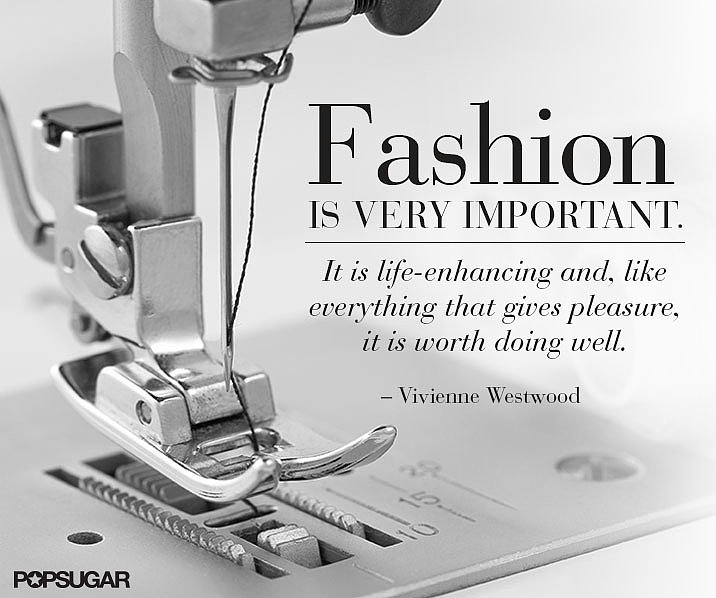 There are many reasons for why fashion is important. First of all, fashion is a way of self-expression! Personalities, moods, interests, hobbies, and more, can often be determined by the clothing styles, colors, and patters a person wears. Clothing items such as shirts can be customized with any image, saying, or design, which allows it to be easier to have a wide array of different buyers and clients. Also, people may wear outstanding clothing to stand out from the others around them, or because it fits your personality. In the morning when determining your outfit for the day, you constantly think about what might look acceptable together and which other garments and accessories could match with it, which helps you become more creative. Fashion can help your creativity level. Next, fashion plays an extreme part in different cultures and religions. For example, Hindus occasionally wear white as a religious color. Some religions have rules for modesty and clothing helps obey those rules by covering the body as needed, to fulfill the feeling and appearance of modesty for that person. In addition, fashion can help with self-confidence. Children of younger ages wear different styles of clothing than the average adult, and same goes for adults and the elderly. If a child wants to feel more grown up, they may wear adult clothing to allow themselves to feel more mature, especially if they want to prove to others they are not the little kid they see them to be. For interviews and occupations, one may wear professional-looking clothes to give a nice first impression. Fashion is important in many ways and is a big part of every day life whether you realize it or not.
Subscribe to:
Posts (Atom)